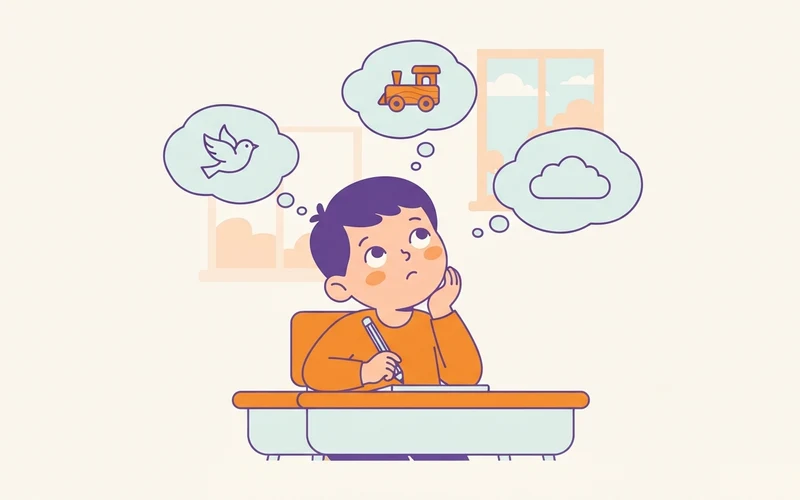
Most focus problems in children come from an attention system that hasn't been trained to filter distraction yet, not from low effort or low intelligence. It responds well to structured practice.
If your child's teacher keeps mentioning "daydreaming," "easily distracted," or "not finishing work" at parent-teacher meetings, you're not alone. Concentration difficulties are one of the most common concerns parents in Kuching bring to us, and in most cases, it isn't about intelligence or effort. It's about how well a child's brain has learned to filter distraction and hold attention over time. Below are seven signs worth paying attention to, and why each one points to a trainable skill rather than a fixed trait.
1. Trouble finishing tasks they start
A child who begins homework enthusiastically but abandons it halfway isn't necessarily lazy. Their attention "battery" may simply run out faster than it should for their age. You'll often see this pattern repeat across unrelated activities: a book put down after two pages, a drawing left unfinished, a chore started but not completed. The common thread isn't the task itself, it's how long sustained effort can be maintained before the brain looks for an exit.
2. Losing track mid-sentence or mid-instruction
If you find yourself repeating instructions two or three times before they register, that's a working-memory and attention issue, not a listening problem. Working memory is what holds an instruction in mind long enough to act on it, and when it's under-trained, information slips out before it can be used, even if your child heard every word clearly.
3. Fidgeting that increases with mental effort
Some fidgeting is normal. But if it visibly increases the moment a task requires sustained thinking, the fidgeting is often a coping mechanism for an overloaded attention system, the body moving because the mind is struggling to hold still on one thing. Watch for the pattern rather than the fidgeting alone: does it spike specifically when the work gets harder?
4. Easily pulled off-task by small distractions
A passing sound, a sibling walking past, a change in lighting: if any of these reliably derail your child's focus, their brain is prioritising novelty over the task at hand more than it should. This is called poor "selective attention," the ability to decide what deserves a reaction and what can be safely ignored, and it's one of the specific skills brain training targets.
5. Careless mistakes despite knowing the material
This is one parents miss most often. A child who clearly understands a concept but still gets it wrong on paper is frequently an attention issue, not a knowledge gap. If your child can correctly explain how to solve a problem out loud, but makes an avoidable slip doing it on paper minutes later, that gap between "knows it" and "executes it" is almost always attention, not ability.
6. Needing instructions repeated even when not distracted
Sometimes the issue isn't external distraction at all. It's that information doesn't "stick" on the first pass, even in a quiet room with nothing competing for attention. This points more specifically to encoding difficulty than to distractibility, and it usually responds well to memory-focused training alongside attention work.
7. Mental fatigue after short bursts of focused work
If 10 to 15 minutes of concentrated effort leaves your child visibly drained, their attention stamina, much like a muscle, hasn't been trained to hold focus for longer. This is often the most encouraging sign for parents, because stamina responds quickly and visibly to consistent practice, usually faster than other attention skills.
What actually helps
Attention isn't fixed. It's trainable. Our #memohack™ program includes brain training exercises specifically designed to build brain speed, energy, connectivity, and stamina, the four pillars behind sustained focus. Sessions combine sensory training (including blindfold-based exercises), memory drills, and timed focus tasks, all calibrated to a child's current level and built up gradually rather than all at once. Many parents are surprised at how much changes in a few months of consistent practice, not because their child suddenly "tries harder," but because the underlying system is doing more of the work automatically.
If several of these signs sound familiar, a trial class is a low-pressure way to see how your child responds to structured brain training. Book a trial class and see for yourself.